
The $322 Billion Number That Can’t Survive Contact With Physics
Goldman Sachs has told prospective SpaceX investors that the company’s AI division will generate $322 billion in revenue by 2030. The figure is the load-bearing wall of a $1.75 trillion valuation pitch. Morgan Stanley, a co-underwriter, puts the same line at $190 billion and projects $3.4 trillion in total SpaceX revenue by 2040. The AI segment’s actual 2025 revenue was $3.2 billion.
Goldman’s number is a 100-fold increase in five years. You do not need to know anything about orbital mechanics to feel the strain in that. But the strain becomes precise the moment you ask what $322 billion in compute-rental revenue actually requires in the physical world. So let us ask.
One note on method. The banks shared the numbers, not the model behind them—so what follows reconstructs what would have to be true for $322 billion to hold. The figures are the author’s; the engineering is not in dispute.
The math nobody runs in the room
The assumed business is renting high-end GPUs—NVIDIA Blackwell B200s or their successors—to AI labs and enterprises. Revenue is just GPUs multiplied by revenue per GPU.
A B200 rented at $5.00 per hour and held at 80% utilization—a realistic average, not a conservative one—earns about $35,000 a year. At that rate, $322 billion requires roughly 9.2 million GPUs running hot. Even on the optimistic end ($6.00/hr, 90% utilization, ~$47,300/GPU), the requirement only falls to 6.8 million. On the low end it climbs past 17 million.
For scale: xAI’s Colossus cluster, one of the largest on Earth, is around 555,000 GPUs. Goldman’s number requires building that more than sixteen times over in four years. NVIDIA shipped an estimated 3.5 to 5 million Blackwell GPUs to the entire world in 2025. The projection asks one ecosystem to deploy and monetize roughly double the planet’s annual Blackwell output—while Microsoft, Google, Amazon, and Meta compete for the same silicon.
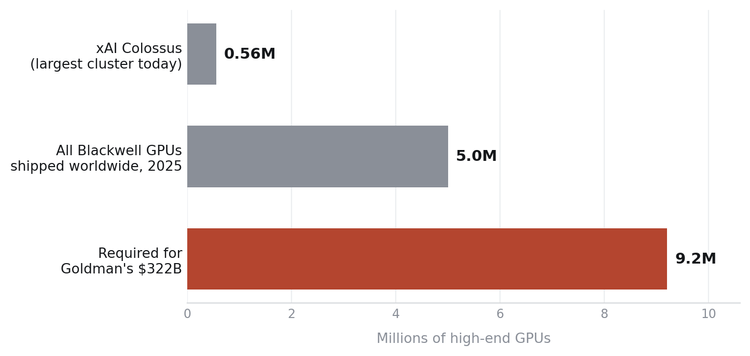
That is the number that has to clear several walls. None of them is rhetorical.
Power
9.2 million GPUs in standard GB200 NVL72 racks (72 GPUs at ~120 kW each) is about 127,800 racks. The IT load alone is ~15.3 GW. Add cooling and facility overhead and total demand reaches roughly 20 GW.
A large nuclear reactor produces about 1 GW. So the projection quietly requires dedicated power equivalent to about twenty nuclear plants, online and feeding one ecosystem, by 2030. For reference, the entire U.S. data center fleet today runs on something like 4–5% of national electricity; 20 GW would be one of the largest single additions to American power demand in history.
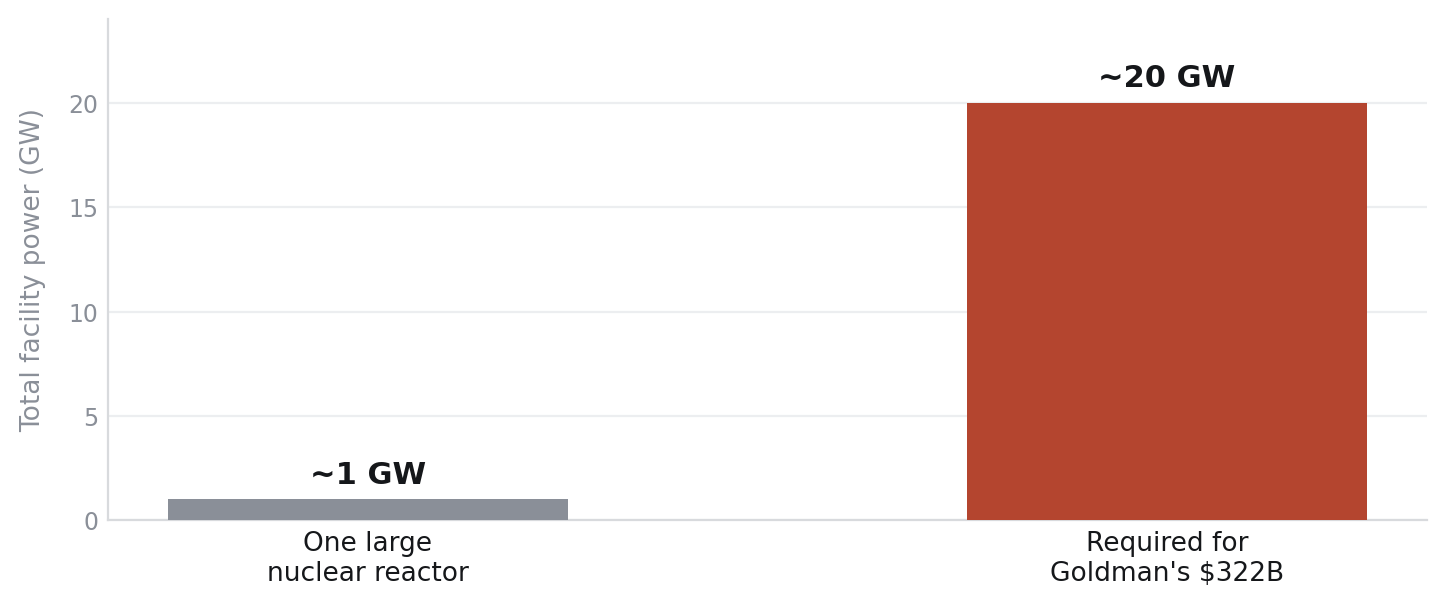
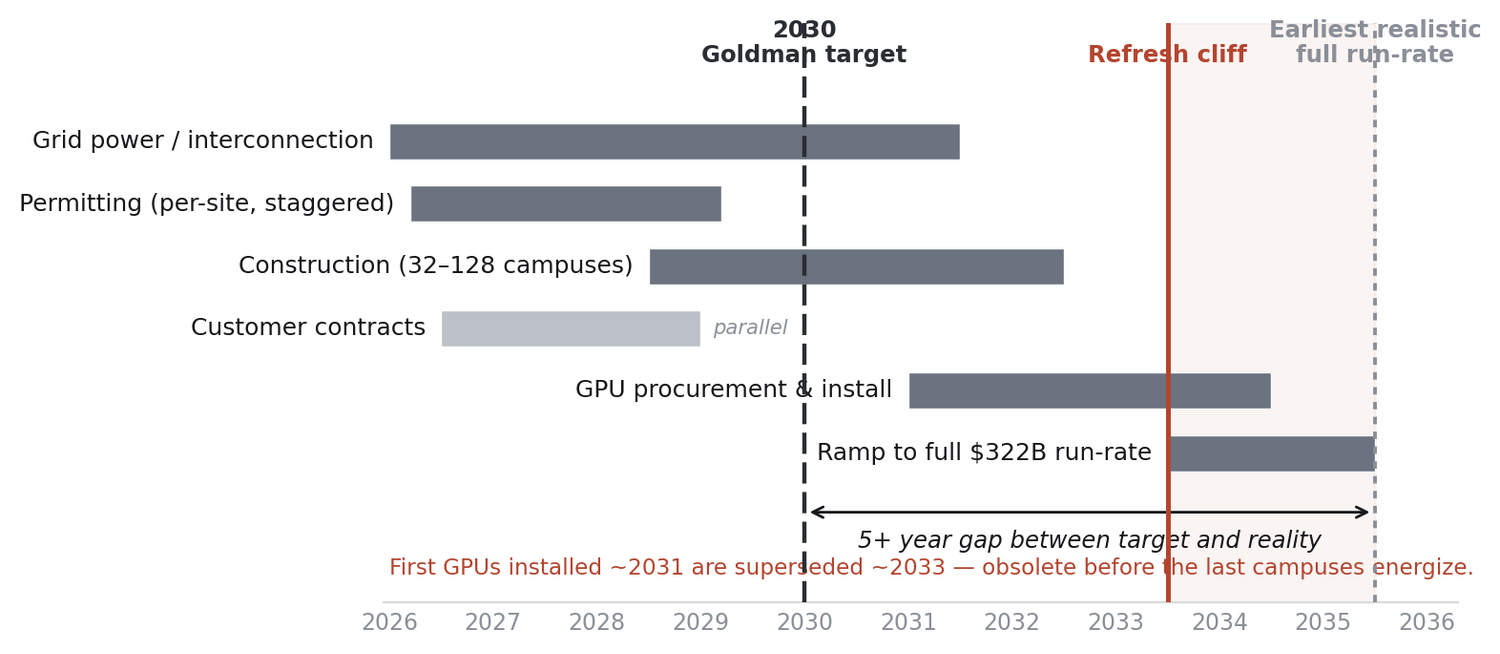
The timelines are the problem. Grid interconnection and transmission upgrades run 4–7 years. Nuclear, traditional or SMR, runs 6–10+. Even gas turbines fast-tracked behind the meter need 18–36 months at volumes that already strain global turbine manufacturing. Hyperscalers with a decade of practice are currently eating 3–5 year delays for power alone, and a meaningful share of planned 2026 builds have already slipped or died waiting for it.
Building and selling it
Those 9.2 million GPUs need 127,800 liquid-cooled racks—the equivalent of 32 to 128 entire hyperscale campuses. A single modern AI campus takes 18–36 months from groundbreaking to full operation with aggressive execution. Permitting adds 12–36 months per site—environmental review, water, interconnection queues, local opposition—and in 2026 roughly a third to half of large planned data centers are already delayed or at risk for exactly these reasons.
Then someone has to rent all of it. Revenue at this scale cannot run on spot pricing; it needs multi-year, multi-gigawatt commitments to hold the 80% utilization the math assumes. Those contracts take 18–36 months to close, with technical due diligence, security review, and SLA negotiation. To bill at full scale in 2030, the bulk of them must be signed in 2027–2028—giving customers years of visibility into a system that does not yet exist.
The capital to do all of this—$15–25 million per megawatt, plus GPUs and networking—lands somewhere between $600 billion and $900 billion in four years. That exceeds the combined annual AI infrastructure spend of every major hyperscaler today.
Stack the timelines honestly—power at 4–7 years, permitting and construction at 2–4, contracts at 1.5–3, none of them perfectly parallelizable—and full-scale deployment takes the better part of a decade. And here the math turns on itself. High-end GPUs hold their competitive edge for two to three years before the next generation roughly doubles performance per watt. The build horizon is three to four times longer than the hardware stays current, which means the fleet the number assumes can never exist at once. By the time the last campuses energize, the first millions of GPUs are no longer top-tier—still drawing full power, earning a fraction of the rate. The $322 billion multiplies 9.2 million GPUs by a current rental rate. You cannot hold both numbers at the same moment. The target isn’t late. It is a finish line moving faster than anyone can run at it.
The accounting wall
Two deals anchor the AI revenue story. Anthropic pays $1.25 billion a month through 2029. Google pays $920 million a month from October 2026 through 2029. Together that’s roughly $26 billion a year—against total company revenue of $18.7 billion in 2025. Two customers more than doubling the business overnight is the proof the $322 billion ramp has begun.
Read the terms and the proof inverts.
Both contracts are cancelable on 90 days’ notice after December 31, 2026. The Google deal carries an earlier trigger: miss the September 30, 2026 GPU-delivery milestone, and after a one-month grace period Google can terminate or take fewer GPUs at a lower fee. So the $26 billion a year is contractually firm through 2026 and optional after—cancelable, by either party, precisely in the 2027–2030 window where the hundredfold ramp is supposed to happen.
That structure is not an accident. It is the entire reason a company like Google—among the largest owners of AI compute on Earth—would lease capacity rather than build it. A short, cancelable arrangement is an operating expense. The customer never capitalizes it as a multi-year asset and a matching liability; it stays off the balance sheet, paid period by period, exited at will. Optionality with no commitment. For the buyer, the cancellation clause is the whole point.
The same clause does the opposite to the seller. Revenue a customer can walk away from in 90 days is not revenue you can carry as backlog. SpaceX can recognize it as the compute is delivered, quarter by quarter—but it cannot book the out-years as contracted, because past the cancellation date there is no contract to enforce. The enforceable revenue is one cancellation window deep. Everything beyond it is forecast wearing a contract’s clothes.
So the same term sits on two balance sheets doing opposite work. It keeps the obligation off the customer’s books and keeps the revenue off SpaceX’s forward commitments. The feature that makes these deals attractive enough to sign is the feature that makes them too soft to underwrite a valuation. You cannot point to $26 billion a year as evidence the ramp is real while the counterparties retain the right to end it before the ramp arrives.
The forecast treats the optional part as the foundation. The contracts were written so it never could be.
The orbital trap
Much of the bull case presumably rests on moving compute to orbit—continuous solar power, cheap Starship launches. The framing inverts the moment you look at it.
Terrestrial data centers refresh GPUs every 2–4 years as performance-per-watt roughly doubles each generation. In orbit, hardware is locked in for 7–15 years, because relaunching and in-orbit servicing are prohibitive. By year four or five, orbital silicon is competing against multiple generations of superior chips on the ground, and the extra hardware launched for radiation redundancy only deepens the loss. That is the definition of a stranded asset, and it destroys the high-margin economics the revenue figure depends on.
This is the same trap that defeats the buildout on the ground, only sharper. Any deployment whose build horizon outruns its hardware’s competitive life is partly obsolete the day it completes. The terrestrial fleet is the chronic case—obsolescing slowly as it scales. Orbit is the acute one, fixed for the life of the launch.
The penalties compound. Heat has to be radiated in vacuum, demanding enormous radiator arrays that scale with load and add launch mass. Radiation hardening raises per-chip power draw. Robotic servicing at data-center density does not exist; a failure means de-orbiting an expensive asset. And round-trip latency of 100–500+ ms confines orbital capacity to the lowest-margin, latency-tolerant work—batch training, cold storage—not the real-time inference that commands premium pricing.
Independent assessments agree this is not a 2030 story. The GAO does not see hyperscale orbital deployment as feasible before the mid-2030s. Google’s own analysis reportedly needs launch costs to fall roughly fivefold, to ~$200/kg, with cooling and servicing unsolved before 2035. Industry executives call aggressive two-year timelines unrealistic and cooling the unsolved bottleneck.
What the number is for
None of this requires any single forecast to be wrong about the future. It requires only that you notice what the forecast is actually made of: manufacturing, power, concrete, permits, and signatures—each on a clock that does not bend to a spreadsheet, all of them somehow synchronizing perfectly inside a four-year window, starting from $3.2 billion.
The revenue figure looks clean because a spreadsheet has no units for gigawatts, permitting queues, or the speed of light. The physical world it implies has never been built at this scale or this speed in the history of electricity.
The number was never a prediction of what SpaceX will earn. It is a number engineered to survive a meeting—long enough for the IPO to price, the allocations to clear, and everyone who signed it to have moved on by the time the physics sends its bill.