Mission: Impossible
The $322 Billion Number That Can’t Survive Contact With Physics
Why Goldman Sachs and Morgan Stanley’s SpaceX AI revenue projections collapse under basic engineering, power, and commercial scrutiny.
Praveen Varma
June 10, 2026
Goldman Sachs has told prospective SpaceX investors that the company’s AI division will generate $322 billion in revenue by 2030.
The figure is the load-bearing wall of a $1.75 trillion valuation pitch. Morgan Stanley, a co-underwriter, puts the same line at $190 billion and projects $3.4 trillion in total SpaceX revenue by 2040. The AI segment’s actual 2025 revenue was $3.2 billion.
Goldman’s number is a 100-fold increase in five years. You do not need to know anything about orbital mechanics to feel the strain in that. But the strain becomes precise the moment you ask what $322 billion in compute-rental revenue actually requires in the physical world. So let us ask.
One note on method. The banks shared the numbers, not the model behind them—so what follows reconstructs what would have to be true for $322 billion to hold. The figures are the author’s; the engineering is not in dispute.
The math nobody runs in the room
The assumed business is renting high-end GPUs—NVIDIA Blackwell B200s or their successors—to AI labs and enterprises. Revenue is just GPUs multiplied by revenue per GPU.
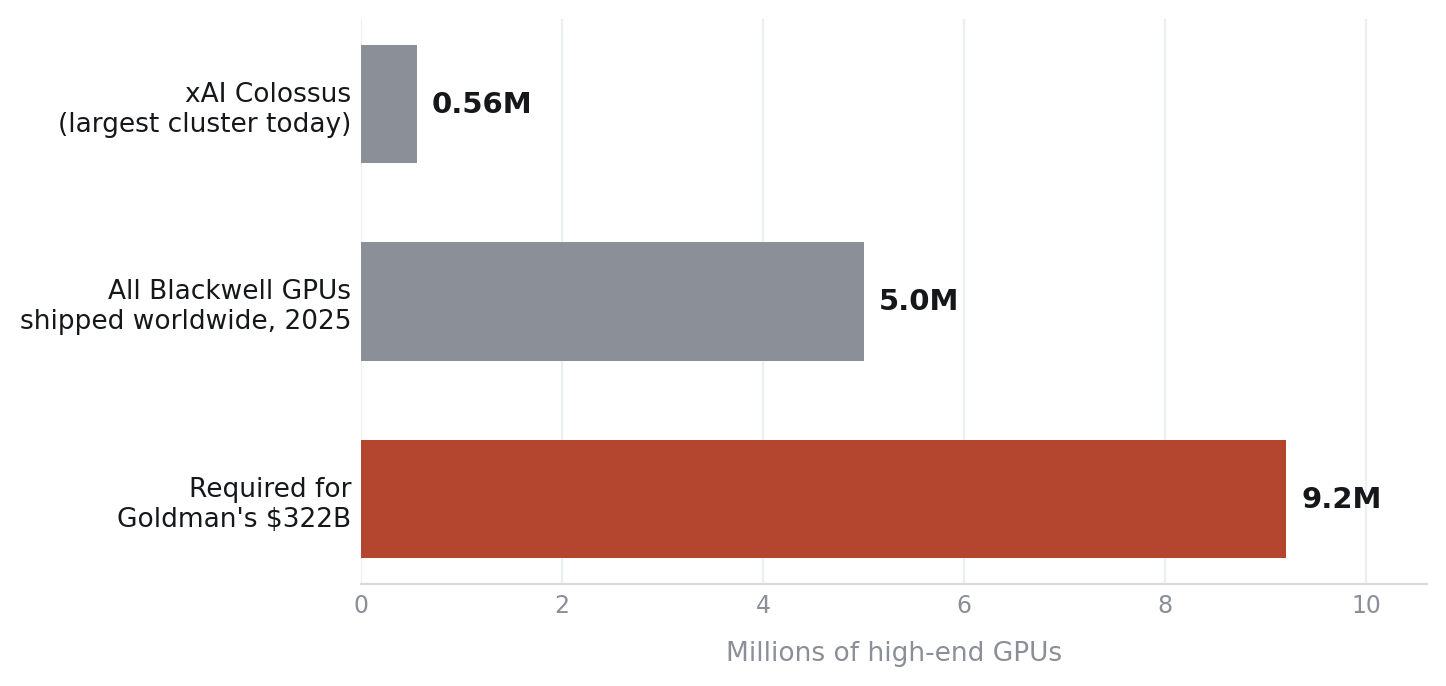
A B200 rented at $5.00 per hour and held at 80% utilization—a realistic average, not a conservative one—earns about $35,000 a year. At that rate, $322 billion requires roughly 9.2 million GPUs running hot. Even on the optimistic end ($6.00/hr, 90% utilization, ~$47,300/GPU), the requirement only falls to 6.8 million. On the low end it climbs past 17 million.
For scale: xAI’s Colossus cluster, one of the largest on Earth, is around 555,000 GPUs. Goldman’s number requires building that more than sixteen times over in four years. NVIDIA shipped an estimated 3.5 to 5 million Blackwell GPUs to the entire world in 2025. The projection asks one ecosystem to deploy and monetize roughly double the planet’s annual Blackwell output—while Microsoft, Google, Amazon, and Meta compete for the same silicon.